
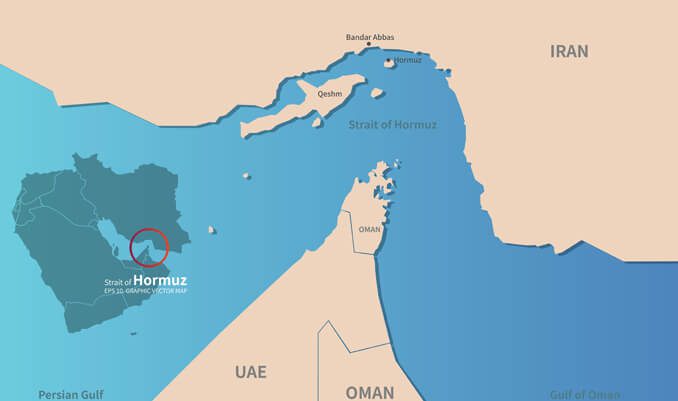
Despite threats to close the Straits, it seems unlikely that Iran could in fact achieve this. At their narrowest the shipping lanes are still two miles wide. The US naval forces in the area are unlikely to stand by and allow Iranian vessels to mine the area and, even if they did mine the Straits, the US naval fleet would likely deploy minesweepers to remove the mines.
There is of course a risk that a military strike on one or more tankers could seriously disrupt the transit of vessels through the Straits. This has not happened yet, but it is possible that a stricken tanker could sink causing an obstruction and/or pollution. Even then, transit under caution may still be possible. The real risk however is the increase in insurance premiums that we have seen over the last few days since the US commenced its attacks and Iran has rained down missiles on those whom it perceives support the US. A fully laden tanker is worth hundreds of millions of dollars. Those interested in the ship and cargo are unlikely to want to risk the loss of their property in the absence of available insurance. Add to that the lives of those who sail on those ships. Even if ship and cargo can be insured (at huge cost) to enable oil and LNG to flow through the Straits, what about the value of those who risk their lives to run the gauntlet?
The importance of the Straits cannot be underestimated. About 20% of world’s global oil flows out through the Straits, some of it from Iran itself. We have already seen the oil price spike. Aside from that however, Qatar is a major LNG producer. That LNG needs to go through the Straits to markets in China, India, Japan and South Korea. We have already seen the global gas price spike, even for those of us in Europe who don’t depend on LNG from the Middle East. That’s a reflection of the anticipated supply chain disruption from the US Iran conflict. Then there’s ammonium nitrate fertilizers one third of which pass through the Straits. Each of these commodities are important for the global economy.
Against this background we also have the dark fleet and Russian oil supplies. Those have been permitted under the price cap, but will we see more breaches of price cap now that the oil price has spiked? Will the Iranian problem lead to more sanctions issues as Russian oil becomes more important to nations seeking to replace disrupted supplies from the Middle East via Hormuz?
We also expect to see huge freight increases for tankers as the supply of available vessels diminishes. But will the dark fleet respond? Those ships are less likely to be insured and so perhaps prepared to take on additional risks.
As you can imagine, this is fertile ground for shipping lawyers. Aside from the risks of possible casualties in the area which give rise to a panoply of legal issues including salvage, GA, loss of life, pollution response, insurance claims and potential wreck removal issues, there are also impacts under charterparties if ships seek to deviate and/or they refuse to transit through the Straits and effectively become trapped in the Persian Gulf. The last time this happened was in the 1980’s during the Iran Iraq war when both sides attacked neutral ships as what became known as the “tanker wars” effectively blocking them such that the only way out was via US escort.
Legally, under the Hague-Visby Rules, carriers are permitted to deviate to safeguard life or property at sea. Most charters contain liberty clauses allowing deviation under specific circumstances. If there are no such clauses then deviation may also be permitted under English common law principles. The leading case on deviation is The Hill Harmony [2001] 1 Lloyd’s Rep 147 which sets out when and how deviation can occur without breaching the terms of the charter. It is also important to consider if the charterparty terms are incorporated into bills of lading to determine what the carriers’ rights are when it comes to deviation.
Another issue that may arise is frustration and force majeure. The former is a common law doctrine which arises when an unforeseen event renders contractual performance impossible or radically different to what was originally contemplated. An example would include a ship becoming blocked or trapped for a long period – as happened to some vessels in the Black Sea after the Russian attack against Ukraine in 2022. Force majeure is often confused with frustration. However, it applies only via a clause in the contract which sets out when one party can suspend or terminate due to a particular named event.
As for charterers of ships heading through or about to head through the Straits, what is their exposure if something happens to the chartered ship? As a matter of English law, charterers are required to nominate prospectively safe ports. A port is considered unsafe if, at the time of nomination, it exposes the vessel to danger that cannot be avoided by good navigation and seamanship (The Eastern City [1958] 2 Lloyd’s Rep 127). This extends not only to the port but also the approaches to the port. It follows that all ports within the Straits may be arguably unsafe. If a previously safe port becomes unsafe then the ship owner is within its rights to request alternative orders. However, if there are ways to reduce the risks then that is relevant. For example, proceeding under US military convoy or sufficiently away from the Iranian coast might make a difference. To be unsafe the port and its approaches need to be exposed to substantial risks that cannot be avoided via other means.
Is insurance the way out of all this? Well – yes and no. Most charters contain standard war risk clauses such as CONWARTIME (for time charters) and VOYWAR (for voyage charters). These clauses allow the Master to refuse orders to enter a high risk area if, in his reasonable judgment, the vessel, crew, or cargo may be exposed to war risks. There have been several cases on this over the years given the threats of piracy off Somalia and attacks by Houthi rebels on ships proceeding through the Red Sea to Suez. In a case called The Triton Lark [2012] EWHC 70 (Comm) it was said that the Master’s judgment must be based on objective evidence and a real likelihood of danger. So, he can’t refuse to transit if he’s merely uncomfortable about the risks. The English Supreme Court in The Polar [2024] UKSC 2 decided that if the risk was already known and accepted at the time of the charterparty, refusal to comply with orders requires a material increase in risk not just a continuation of existing conditions.
In practice, those who charter ships to carry cargoes that involve transit through the Straits will seek to put pressure on the ship owners to transit. It is usually required that the charterers pay the additional war risk premiums. But even with all this, it is possible that a Master can justifiably refuse to transit as he has responsibility for the lives of those on board as well as for the ship and its cargo.
To sum up, we expect to see many legal issues arise from a protracted conflict in the Middle East. We would urge our clients to respond proactively by looking at their contractual terms and consulting us if they perceive an issue.

Nick Burgess
Partner


